Have you seen some thought-provoking and insightful quotes written on London Underground's message boards circulating online? This practice of writing a daily quote started in 2004 in London's Oval station where the customer services manager thought of writing quotes from his favorite book, Tao Te Ching.
Then something wonderful happened. Commuters started approaching the station's staff to tell them how the quotes inspired them or how the quotes talked to them and helped them get answers to whatever they were going through in life. Eventually, the other stations picked up the initiative.
Today, 15 years later, the Oval station and other London Underground stations are able to spread the inspiration and wisdom to the rest of the world via social media. Isn't just amazing how these quotes which were just meant for the daily commuters of London are also able to impact the lives of people across the globe?
Sharing with you some quotes I like from recent IG posts:
You cannot suffer the past or future because they do not exist.
What you are suffering from is your memory and imagination.
We are not given a good or bad life. We are given a life and it's up to us to make it good or bad.
One day you will tell your story of how you've overcome what you're going through now and it will become part of someone else's survival guide.
Doubt kills more dreams than failure ever will.
I've seen better days but I've also seen worse.
I don't have everything that I want but I do have all I need.
I wake up with some aches and pains, but I woke up.
My life may not be perfect but I am blessed.
You're not going to master the rest of your life in one day. Just relax. Master the day. Just keep on doing that every day.
Some of the quotes are funny too. Here are some of them -
I can't decide if people who wear pajamas in public have given up on life or are living it to the fullest.
I'm in a really good place . . . I don't mean spiritually or anything; I am in bed with cake. 😂
It's fascinating to learn about other cultures. It's a pleasant surprise if you see some similarities with your own but a greater surprise if you discover something unique.
Take for example the Swedish word lagom which I learned from the book Lagom: Not Too Little, Not Too Much: The Swedish Art of Living a Balanced, Happy Life by Niki Brantmark. In the Filipino language, we have a similar term called "sakto" but I don't think it has ever been used to describe a balanced life. I guess because sakto refers more to achieving the minimum level required rather than a certain level of satisfaction. But then again, I am not a language expert so I could be wrong.🙊
In Swedish, lagom is often loosely translated as everything moderation or finding a balance that works for you. Guess where it originated? From the Vikings. According to the book, lagom is rooted in the term laget om (around the team). It is said a bowl or horn of mead (alcoholic beverage created by fermenting honey with water) would be passed in a circle, and it was important that everyone only sipped their ‘fair share’ so there was enough to go round. So lagom is also closely linked to working together for the collective good, fairness and equality. Such a nice concept, right?
You can use lagom to describe anything that seems right for you. You can refer to water as lagom water if the temperature of the water is right for you. You can refer to your pants as lagom pants if they fit you well. So it's lagom <any thing> so long it's "just right".
What other interesting things did I learn about the Swedish culture from the book?
The author shared that living in Sweden reminded her that one doesn’t have to spend a lot to have a magical holiday because Swedish summer holiday is about taking time out and going back to basics to enjoy the simple things in life – whether that’s simply hanging out at home or heading to a small, basic summer cottage by the sea or deep in the heart of the countryside, to enjoy reading, baking, bathing, board games, crafting or simply hanging out with friends and family and drinking in as much sunlight as possible before the autumn leaves start to fall.
I hang out at home most of the time, I enjoy the simple things in life everyday and I read everyday - not a lot of people don't understand why I enjoy all of these so much but good to know that somewhere across the globe, such activities are treasured. I am officially on a magical holiday year-round! 😂
Lastly, I also like the Swedish concept of fika - taking time for coffee, treats and conversations. The author said fika could be casual catch-up with a friend or a more formal one at work with colleagues. Whether it's formal or informal, the author said it’s about taking time to switch off for a few minutes and giving yourself a breather.
I love breathers and they don't even have to include coffee, treats or conversation. Walking alone is a perfect breather for me. 😎
I thought I knew enough about the Japanese but surprise, surprise, after reading "A Geek in Japan: Discovering the Land of Manga, Anime, Zen, and the Tea Ceremony" by Hector Garcia, I discovered a lot of other new things. Here are 10 of them covering Japanese customs, art, etiquette and values:
1. Valentine’s Day is a big celebration in Japan. On this day, women give chocolates to men - not just for the man they love but to all the men they are close to such as friends and colleagues. So there are 2 kinds of chocolates women choose from: (a) “giri chocolate” (given by women as a social duty) and (b) “true chocolate” (given to the man they love).
After men receive chocolates, they feel now morally indebted to the women. Given the Japanese giri system (giri is somewhat the Japanese version of "utang na loob" or profound duty to return gratitude for what you have received), on March 14, men return the gesture to women. They give women white chocolate.
2. Have you noticed how Japanese women tend to cover their mouth when they laugh? This could gesture that was handed from one generation to another.
Apparently, for centuries, a woman showing her teeth or her open mouth has been considered more or less indecent in Japan. During the Nara Period (710–794), there started a custom that was known as ohaguro (meaning “black teeth”), which required a Japanese woman to dye her teeth black. Initially this meant a girl had become a woman, however, during the Edo Period (1603–1868), the meaning changed. Having black teeth became a sign that a woman was married.
For more than 200 hundred years, many married women blackened their teeth. And they didn't feel comfortable with the blackened teeth so when they laughed, they unconsciously covered their mouths.
3. Ikebana means “live flower” and it's a Buddhist practice that first appeared in Japan in the sixth century (I never knew this art was that old.). And beyond just arranging flowers for decorative purposes, ikebana is actually a method for meditation. The positioning of flowers is important based on a lot of elements such as simplicity, the flow of life, seasons, etc.
4. There's a Japanese art called "Ukiyo-e" which literally means “pictures of the floating world.”
Popular themes are kabuki theater performances, portraits of geisha, samurai, sumo wrestlers, scenes with Mount Fuji in the background, etc.
Below is one of the most popular Ukiyo-e prints by Hokusai (one of the 2 most popular Ukiyo-e artists; the other being Hiroshige). Hokusai is said to have created more than 30,000 original pictorial works, and he is famous for the Thirty-six Views of Mount Fuji series. This is one of the 36 prints with Mount Fuji in the background.
Source
But what's amazing about this art is how it's done and how it is mass produced (the quantity would depend on the stature of the artist). The process wasn't in the book but I researched it online. A Japanese artist would sketch the design using ink lines, then a wood carver carves the design on a block of wood. This would serve as the ink plate for printing the black outline. Then more blocks are carved out, one per color, and these would serve as the color plates. A printer then applies color on the black outline under the artist's supervision. To make sure the colors don't go out of place, each block has a marking to make sure the paper is set on the block in the right position. Such detail and precision.
Each print of the same design would be numbered (depending on the final quantity), then the original block was destroyed in order to ensure that buyers owned something unique.
5. The father of Manga is Osamu Tezuka. Story has it that his inspiration was Disney animation which he combined with Japanese arts and his own innovation, giving birth to a new genre. He finished is first Manga in 1947 and quickly sold 400,000 copies. That must be a lot in the 1940s!
But what's amazing for me about manga are the superheroes. For the action superheroes, they are usually mortals who since their childhood, had sacrificed everything for their passion to become better at what they do. The common them in a lot of manga is - If you work hard, you can achieve anything. What a nice underlying theme.
Another interesting thing about manga is that enemies are evil at first but usually, in the end, their good side is revealed.
Tezuka died when he was only 60 but left a legacy of more than 150,000 pages and 60 animated movies. He produced an average of 10 pages of manga a day. 😮
Tezuka’s Atom (Astroboy to us) has become one of the icons of Japanese pop culture.
6. Meishi means “business card”. The are certain rules on how to treat a meishi.
You should take it with both hands.
You should not fold it.
You should not stick it in the back pocket of your pants.
You should not write on it. (This is the new thing I learned about meishi. I sometimes write on them if I want to remember something about the person or the company's products or services.)
7. The Japanese give omiyage to their colleagues after coming from trip (omiyage is the Japanese version of "pasalubong"). When one comes back to work, they must bring a small gift, usually sweets, to share with colleagues. They approach their coworkers offering the sweets and when they finish going around, the leave the remaining omiyage in a common spot in the office, usually near the coffee machine.
8. Honne are wishes, opinions, and the true feelings an individual has versus tatemae which are social obligations and opinions that the individual should say based on what is appropriate to say.
Sometimes what is tatemae doesn't match one's honne and in Japan, knowing how to express tatemae and honne at the right time is considered a virtue. This is because in Japan, preserving harmony is more important, thus, sometimes, true thoughts (honne) are not explicitly verbalized so as not to hurt people’s feelings.
An example given in the book is when you’re invited to tea at a Japanese home, and as dinnertime draws near your hosts may ask you - “Would you like to stay for dinner?”. This is tatemae, something the host needs to do out of social obligation. In return, you should answer something like, “I’m not hungry, thank you.” (Good thing I have read this book! I might immediately say yes coz how can I say no to an authentic Japanese home-cooked meal? 😅)
9. The Japanese have a kind of party known as nomikai. This is where coworkers would go to an izakaya (Japanese traditional bar) to chat, eat, and drink. This is their opportunity to show their honne (true feelings and opinions) and talk about their problems at work or in the family. Drinking alcohol allows them to open up and express their real thoughts and feelings and not be judged as improper. Expressing your honne during nomikai is acceptable.
10. One outstanding quality of the Japanese which I highly admire is their modesty and humility - no matter what their social class, talent, or job position is. They never talk about their achievements unless asked but even when they answer, they downplay it and attribute their success to the people around them. In Japan, humility is one of the bases of professional success.
The book cited 2 very well-known sayings in Japanese on being humble:
“Nou aru taka wa tsune wo kakusu”–Talented eagles hide their claws.
“Deru kui wa utareru”–Stakes that stick out can be hammered.
Do you have the tendency to buy books with the intention of reading them someday but don't end up reading them until they become a pile of unread books on your shelves?
I used to be guilty of this during my pre-Kindle days. Whenever there's a book sale, I hoard books. But I don't end up completely reading some of them when they fail to pique my interest or engage me after reading a few chapters.
But gone are those days since 2010 when I shifted to e-books coz now I can buy any book any time. I could even download a free sample of the book before buying to make sure I like the writing style.
But guess what? There's a Japanese term for the tendency to collect books which are left unread. The term is "tsundoku" where "tsun" originates from the word "tsumu" which means to pile up and "doku" can be used as a verb which means "reading".
A professor from the University of London who studied the term shared that tsundoku was found in Japanese literature as early as 1879! 😮 The specific phrase used in the literature was "tsundoku sensei" referring to a teacher who has lots of books but doesn't read them.
So to all of us who once had this tendency or still have this tendency, we're not alone. There are other people like us from centuries ago who were guilty of tsundoku. 🙈 But the only difference is that today, we have more access to literature like never before, thus, it's easier for us to overcome this book hoarding madness.
If you want to take the first step in overcoming tsundoku, it's important to first accept and admit that you won't realistically read all those books in the coming months. If you haven't read them in years, what makes you think you'll be able to read them now? 😜 Some of these books could also be on subjects that are no longer relevant for you now or topics you may have outgrown or lost interest in. Thus, you may want to consider giving them away. A great organization where to donate them is Caritas Manila's Segunda Mana.
Instead of these unread books gathering dust on your shelves and occupying space, they would be of better use if they will be in the hands of someone who would read and learn from them. Besides, books would only serve their purpose if they are read. :)
My gadgets - computer, tablet and phone - all have washi tape that cover the cameras. Yes, including the front camera of my phone coz I don't take selfies anyway. 🙈😂 Why? Coz I've heard that with the sophisticated technology nowadays, someone could actually control your phone's camera or microphone and take data anytime. And it doesn't help if you've seen an episode of Black Mirror. 😱🙈
Then last weekend, I read this article from The Guardian entitled "Are your phone camera and microphone spying on you?". According to the article, if you have installed any app that allows you to do voice calls, video calls and send images, and gave that app permission to your camera and microphone, that app could technically do the following:
Access both the front and the back camera.
Record you at any time the app is in the foreground.
Take pictures and videos without telling you.
Upload the pictures and videos without telling you.
Upload the pictures/videos it takes immediately.
Run real-time face recognition to detect facial features or expressions.
Livestream the camera on to the internet.
Detect if the user is on their phone alone, or watching together with a second person.
Upload random frames of the video stream to your web service and run a proper face recognition software which can find existing photos of you on the internet and create a 3D model based on your face.
Scary, right?
The article also goes on to cite real-life cases on how other parties could collect data from you including the government and hackers.
What could you do? Make sure to only download apps from reputable developers. But even if they are from reputable companies, you don't have to give the apps permission to your camera or microphone the entire time if you only use the app for other purposes e.g. just reading content or sending text messages. Then, in the few times when you need to use the app/s for voice or video chats, or to send images, you can temporarily give access to the specific app to your camera or microphone. It's a bit of a hassle but it may be all worth it for privacy and peace of mind.
I've only heard about the concept of capsule wardrobe / capsule closet in the last 2 years but guess what? "Capsule wardrobe" was coined in the 1970s by a London boutique owner named Susie Fox. But the term gained popularity when American designer Donna Karan released a capsule collection of 7 interchangeable work-wear pieces in 1985.
What does capsule wardrobe or capsule closet mean? It's having a collection of clothes that you could mix and match. The goal is to be able to create different outfits for various occasions without owning too many clothes. This is usually achieved by buying key items in coordinating colors.
Some people have taken personal challenges revolving around the capsule closet concept like Project 333 wherein you select 33 clothing items which you would wear for 3 months (and packing everything else until it's time for a quarterly rotation). There's another one called 10 x 10 challenge where you choose 10 items (a pair of shoes are counted as an item) which you have to wear for 10 days. The catch is you can't wear the same outfit on multiple days coz the objective is to be creative in mixing and matching your clothing items. 😬
But nope, I haven't really taken any of these challenges coz my wardrobe is already down to staple wear. 😂 And my clothes look the same - same cut for all my pants, one style for all my skirts and dresses, similar style and colors for all my tops ... 🙈😂
I know my wardrobe sounds so plain and boring but I've been through the phase wherein I would buy something different from my usual style and colors then not end up wearing them. During that time, my closet may be packed with clothes but I would have mornings where I still find myself saying I don't have anything to wear. 🙊
When I read Garance Dore's Love x Style x Life a few years back, I love and could very well relate to what she said which goes - "I find myself buying the same things over and over, but I don't mind - these are my classics, they always work, they always make me happy." Our only difference is she's very fashionable and I'm not. 🙈😂 😂
Anyway, I think the important lesson from the concept of capsule wardrobe beyond item counting is to make sure that we only buy and keep clothes that we love to wear and that we actually wear. When you love all the clothes in your closet (no matter how few they are), you'll never have "I've nothing to wear" episodes in the morning. 😜
I'm a big Harry Potter fan. I started reading Harry Potter and the Philosopher's Stone the first year the book came out. I have all the physical books of the Harry Potter series - they are the very few physical books I've kept after I started streamlining my book collection.
You could just imagine that visiting the Harry Potter Warner Bros. Studios was one of my top itinerary during my trip to London. I didn't have Kensington Palace or Buckingham Palace in my itinerary but I had Harry Potter Warner Bros. Studios. Haha...
Sharing with you my Harry Potter Studio Tours adventure. But if you want to go straight to the travel tips, I have compiled them at the end of the post. :)
The HP tour experience starts with a bus ride as the location of the studios is out of the way.
The place where the studios are used to be a local airfield factory. During World War 2, the plant produced fighter places for the Ministry of Defense and later on, it was used as a production center for Rolls-Royce aircraft engines.
As soon as you enter the lobby of the studios, you could already feel the excitement as there are already HP props on display. At the time when we went there in October, there was even a display of some costumes from "Fantastic Beasts and Where to Find Them" but since the movie hasn't been shown yet at that time, I couldn't relate. Haha... But I heard parts of Fantastic Beasts were shot in the studios too so I am sure in the coming years, new sections would be added to include Fantastic Beasts.
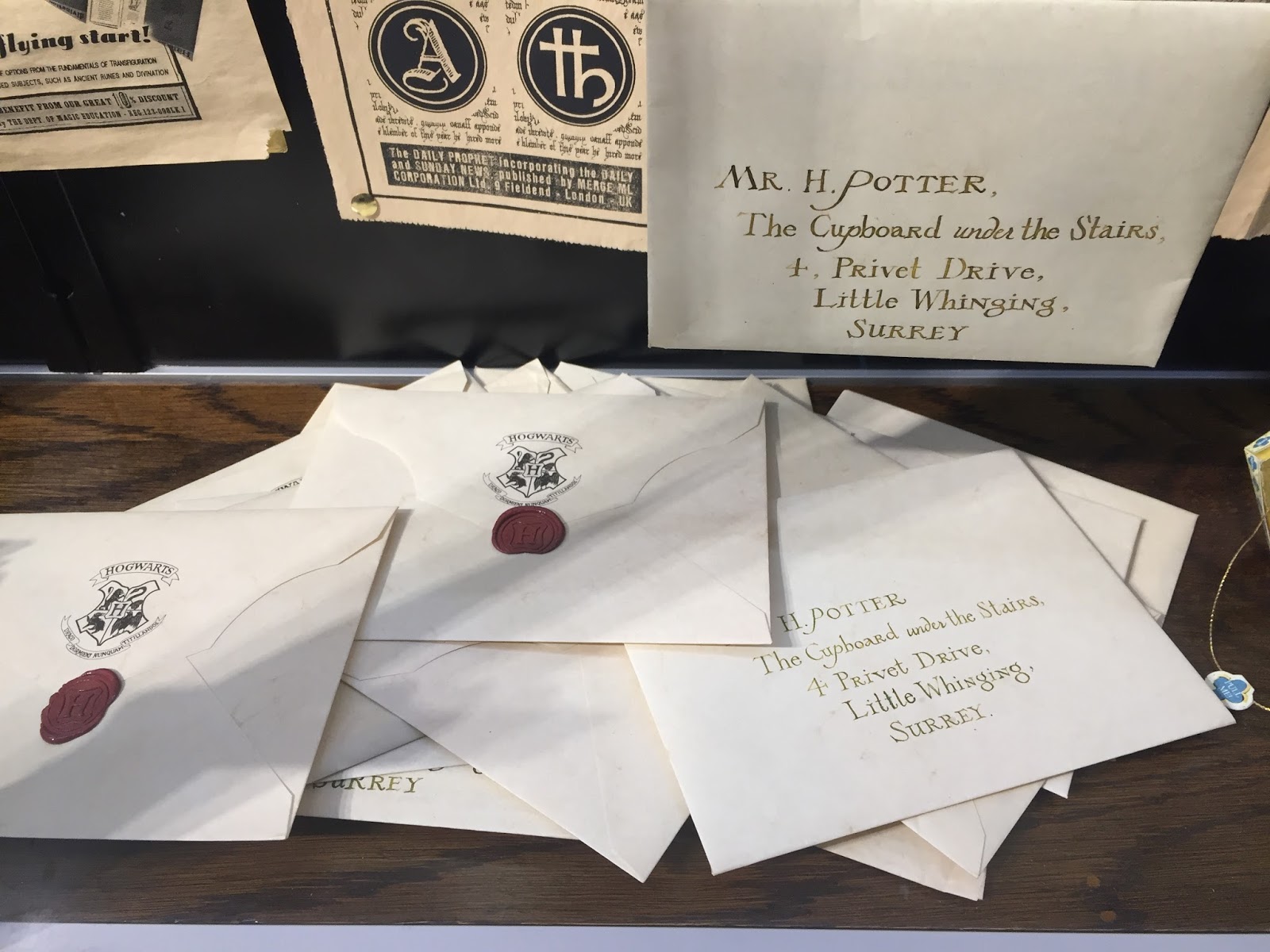
Anyway, while lining up at the entrance, the first set that you'll see is Harry's first bedroom - The Cupboard under the Stairs - at the Dursley's home at #4 Privet Drive.
Harry's first bedroom at Privet Drive
Like any other tour, it starts with a short video hosted by HP leading characters Harry, Ron & Hermione. The video would make you appreciate the movies better as it gives recognition to the creative and hardworking HP crew who worked on the HP movies for 10 years. Yes, the studio was home to HP actors and crew for 10 years. Imagine, the kid actors spent most of their childhood years in that studio.
After the introductory video, the tour officially starts with the opening of a set of big doors that lead to the Great Hall -
For HP fans, this is such a special place because it's been used in all movies. It felt so surreal to be walking in the hall with all the familiar things we saw in the movies. Check out the table settings -
Each house has a section in the Great Hall which features the students' distinct look and uniforms.
At the end of the Hall is the faculty of Hogwarts led by Professors McGonagall, Dumbledore and Snape.
McGonagall, Dumbledore and Snape
See the owl podium of Dumbledore above? It's made from real gold and wax!
One of the most popular props in the Great Hall is none other than The Sorting Hat.
The Sorting Hat
The time allocation in the Great Hall is limited since each batch has to vacate this area to give way to the next batch of visitors. This is also one area where you can never go back to so just make sure to maximize exploring the hall while you're there. :)
After the Great Hall, the next section houses a lot of popular sets, props and costumes from all HP movies. If you availed the digital audio guide, it's at this point when you need to start using it. However, in my case, once I saw all the familiar sets, I had sensory overload! I didn't know where to look, what to read and I wanted to take photos of everything! Haha.... In short, since I was so excited to see all the stuff, I opted not to use the digital audio guide at this point thinking it would just slow me down.
To understand what kind of sensory overload I'm talking about, check these out -
Costumes from the Yule Ball. Harry & Cho Chang's in front, and
Hermione and Viktor Krum's at the back.
Yule Ball Ice Sculpture
The Chocolate Feast!
Leaky Cauldron
Inside the Leaky Cauldron
This hallway of the Leaky Cauldron was created using an optical illusion called forced perspective - a technique to make things appear smaller, larger, closer or farther than it actually is. In the case of the hallway in Leaky Cauldron, it makes the hallway appear to be more than 50 ft long on screen. But the actual set isn't big or long at all. A person couldn't even fit in it. :)
Close up shot of the Leaky Cauldron hallway
Hogwarts' Gate
The ceiling of the Great Hall
Remember there are floating candles in the Great Hall? The production crew initially tried real candles on wire but I think the flames burned the wire and some candles fell so they decided to just digitally add the floating candles on screen.
Griffyndor Boys' Dormitory
The bed on the right is Harry Potter's bed. His trunk is marked HP right under his bed.
The beds were built during the first HP film when the actors were still kids. In the latter movies when the actors have grown taller, they had to curl up the beds to prevent their feet from dangling over the edge of the beds. Haha...
This frame contains the wands of the most popular and powerful wizards in Harry Potter books.
Wizards' wands
More Wizards' wands
Do you know how many wands they intricately created for all the HP films? More than 3,000 wands! Whoa....
Beautifully-designed wizard wands
Gryffindor Common Room
This is also one of the most memorable places in HP films where Harry, Ron and Hermione congregated and did a lot of planning.
Fireplace at the Griffyndor Common Room
The Clock Tower at Hogwarts Castle
The Griffin in the staircase that leads to the Headmaster's Office
Dumbledore's office
At this point of the tour, I thought of using the digital audio guide and I'm so glad I did. Apparently, the digital audio guide contains a lot of interesting trivia which you wouldn't get from reading the studio signages. It also helps you direct your attention to the most important things in the room. So instead of getting overwhelmed with so many things to look at, with the audio guide, you know where to focus on. In hindsight, I should have started using the digital audio guide early on! Haha....
Close up shot of Dumbledore's office
The Memory Cabinet
Remember this is where Dumbledore keeps vials of people's memories? It contains more than 800 tiny, hand-labelled vials.
Dumbledore's books
According to the audio guide, hundreds of the books in Dumbledore's office are actually British phonebooks covered in leather. Also, the guide said, somewhere in the bookshelves, you'll find the sword of Gryffindor. I actually couldn't find it. Haha...
Photos of past headmasters in Dumbledore's office
Nope, the photos weren't moving like in the movies. How do they make them move? By using green screen (green frames below).
The guidebook mentions that after all the films were made, a total of 5 giant warehouses were filled with props including 5,000 pieces of furniture, 12,000 hand-made books and 40,000 Weasley Wizard products. Wow!
Here are the most popular props from the movies -
TriWizard Cup and the Golden Egg
Philosopher's Stone
The Golden Snitch
Remembrall
This orb gets filled with red smoke when the holder has forgotten something. Remember that scene when Neville got one? And he said something like - The only problem is I couldn't remember what I've forgotten. Haha...
Time Turner
If you've already read Harry Potter and the Cursed Child, you know that this is the most important magical device there. :)
The Goblet of Fire
You know how big is this goblet? It's 5 feet tall carved from a single trunk of an Elm tree.
The Potions Classroom
Here's the Potions' classroom - there are about 500 bottles with hand-crafted labels that line up its walls.
Professor Snape at the Potions' Classroom
One of the most remarkable characters in HP is Snape that's why a lot of HP fans got sad when Alan Rickman passed away. I couldn't imagine anyone else perfect for the role of Snape other than Alan Rickman.
The animal actors who played Crookshanks
Yes, there are multiple animal actors per role. Even Hedwig was played by 4 different owls - each owl with a different skill.
Hagrid's Hut
Hogwarts Door
The door looks huge in the movie but this is just it. The power of special effects. Haha... So this door was tightly shut in Harry Potter and The Prisoner of Azkaban to protect Hogwarts from the threat of Sirius Black. But though the door is not real size, it doesn't mean it was easy to build. Each bolt, latch and handle were all mechanized by the Special Effects Department. Wow.
The Chamber of Secrets Door
We all thought that the snakes slithering on the door were all computer-generated. Apparently, this door was hand-built by the Special Effects Department and each snake slithers in a slotted track that was powered by a motor at the back of the door. Wow.
Gringotts Vault Door
Green screen for scenes flying on broomsticks
There's a section within the studios where you can actually have your photo taken flying on a broomstick and yes, you'll put on a costume - take your pick if you want to dress up as Gryffindor, Slytherin, etc. They use a green screen as a background and when the photo is generated, you're magically flying in the sky. Queues can be pretty long in this section so just decide if you think it's a good use of your time and money. But my priority is to explore the studios and I'm not also that good when it comes to posing for photos so I didn't have a hard time deciding. Haha...
Moody's trunk
I had to google to refresh my memory on this. So this is a magical trunk that has 7 locks and each one opens to an assortment of items. The 7th lock is where Barty Crouch Jr. imprisoned the real Moody. If you noticed the photo above, there is a mirror on top of the trunk which shows the reflection on what's inside the trunk. There's the image of Moody inside the 7th trunk.
Close up shot of imprisoned Moody inside the 7th trunk
Broomsticks used for Quidditch
There are also pocket of activities inside the studios like learning wand choreography.
One of the more interesting setups in the studio is The Burrow - the home of the Weasleys. You'll see the self-operating objects in the movies like these (in hindsight, I should have taken videos so you could see that they really move! haha...)
Self-washing frying pan
Self-operating iron
Self-knitting needles
The Horcruxes: the diary, ring, locket, cup, Nagini and the diadem
Nagini at the Malfoy Mansion during the Death Eaters' Meeting
Ministry of Magic's colorful fireplaces
Dolores Umbridge's Ministry of Magic Office
Dolores Umbridge's pink dresses
Take a break and check your height :)
Hermione's trunk and school stuff
Platform 9 3/4. You may pose for a photo.
Hogwarts Express
You can go inside the Hogwarts express. There is a compartment that represents each movie - the props used by the lead characters while onboard the Hogwarts Express are on the seats.
Inside the Hogwarts Express
Here's one - just can't remember from which movie is it.
Inside the Hogwarts Express
Goodies sold at the Hogwarts Express
Here are more props used in the movies. Imagine, they created all of these in such great and realistic details -
Costumes worn in the last scene of the last HP movie
when Hermione & Ron, Harry & Ginny were already adults.
In between studio tours, you could take a break at the cafeteria where you can order a glass of Butter Beer. How does it taste? It takes like butter candy in liquid form.
Butterbeer
From the cafeteria, the next would be outdoor sets.
The Knight Bus
The Knight Bus is a 22 feet, triple-decker bus. It was created from pieces of 3 vintage double-decker London buses.
#4 Privet Drive
Hogwarts Bridge
Inside the Hogwarts bridge
From the outdoor section, you'll go back inside again for the last leg of the tour. Here's what's in store -
Masks and Prosthetics
Dobby
Dobby
Aragog. Did you know it took 100 technicians to operate this thing?
The basilisk
Gringotts
Diagon Alley
Ollivander's Wand Shop
Do you know how many wands does the Ollivander's Wand Shop contain? 17,000 individually-labelled wand boxes!
Check out how much detail they've put into each store.
There's also a section which shows the various works of the Art Department where they had super detailed sketches of each structure and from these sketches, they built prototypes, and from the prototypes, they built the real thing. So here's the prototype of the Hogwarts Castle -
Hogwarts Castle prototype
And here's the final work -
Hogwarts Castle
Hogwarts Castle is just a scale model which is made to look big on screen.
This section is actually the last room before the exit. When you're in this section, I recommend that you stay for a few minutes for 2 reasons: (1) marvel at the details of the castle and (2) see how the castle looks like at different times of the day with the use of lights. Check these out -
Hogwarts Castle at sunset
Hogwarts Castle at night
Hogwarts Castle at dawn
When you zoom in on the details, the castle does look big. Amazing details -
By the time we were at the Hogwarts Castle section, the studio was already announcing that they were about to close. We just finished right on time. Whew!
BTW, the photos I shared here are just some of the photos I took. I have several hundreds more! Haha.... I am not kidding when I said it was sensory overload. Haha...
Anyway, I compiled some useful tips below if you're planning to visit the Harry Potter Studios in London.
1. Purchase tickets way in advance. We got tickets online a week before our trip and sadly, all the morning slots were taken - even on weekdays. The earliest time slot available was 3:30pm and the closing time for that day was 7:30p.m. Four hours isn't just enough. BTW, closing time varies depending on the day and the season so just double check before purchasing a ticket. The official website is at https://www.wbstudiotour.co.uk/.
2. If you're an HP fan, get the Complete Tour Package at €48.95. This package includes a studio ticket, a digital audio guide and a paperback souvenir guidebook - the ultimate experience if you're an HP fan. Haha... Make sure that you use the digital audio guide because other than interesting trivia and behind-the-scene stories, it would help you focus on the most important items to look at in the sets.
3. The Harry Potter Warner Bros Studios is outside the city. Know the directions on how to get to the Watford Junction station, the estimated travel time and the Harry Potter bus schedule in advance so you won't be late for your scheduled time slot. You may use the tool in their website at
4. The bus ticket is a separate fee. Make sure to keep your ticket since the bus driver will ask you present it on the return trip.
5. Lastly, eat a big meal before going to the tour. I can't remember if there's real food at the cafeteria other than butter beer. But if you've limited time like us, there's really not much time for a snack break. Plus it's hard to absorb information when you're hungry. Haha...
P.S. October - November was HP overload for me. I tried doing an HP movie marathon before the studio tour to refresh my memory though I never finished all of the movies. I read Harry Potter and the Cursed Child. I watched Fantastic Beasts and where to Find them. After all of these HP-related activities, one night, I dreamt I was talking to a big snake in Parseltongue. Wahaha...