Shinto is one of the major religions of Japan (the other one is Buddhism). Shinto is about living in harmony with nature and all things.
We visited 3 Shinto temples during our recent trip to Japan: the Heian Shrine in Kyoto, and the Asakusa Kannon Temple and the Meiji Shrine which are both in Tokyo.
When entering a Shinto shrine, you’ll notice a special gateway made up of wooden or concrete pillars - this is called a torii. The torii is believed to be the gateway to the gods (kami). It separates the ordinary space outside from the sacred space inside so you have to pass through the pillars.
Torii of the Meiji Shrine
Torii of the Asakusa Kannon Temple
Sometimes hanging on the torii, you’ll notice ornaments. Our tour guide said that the tassels represent rain and the trimmings with sharp edges represent lightning.
Torii of the Asakusa Kannon Temple
The grounds of a Shinto Temple is usually covered with white sand or gravel. Walking on gravel produces a sound which is considered part of your cleansing before entering a temple.
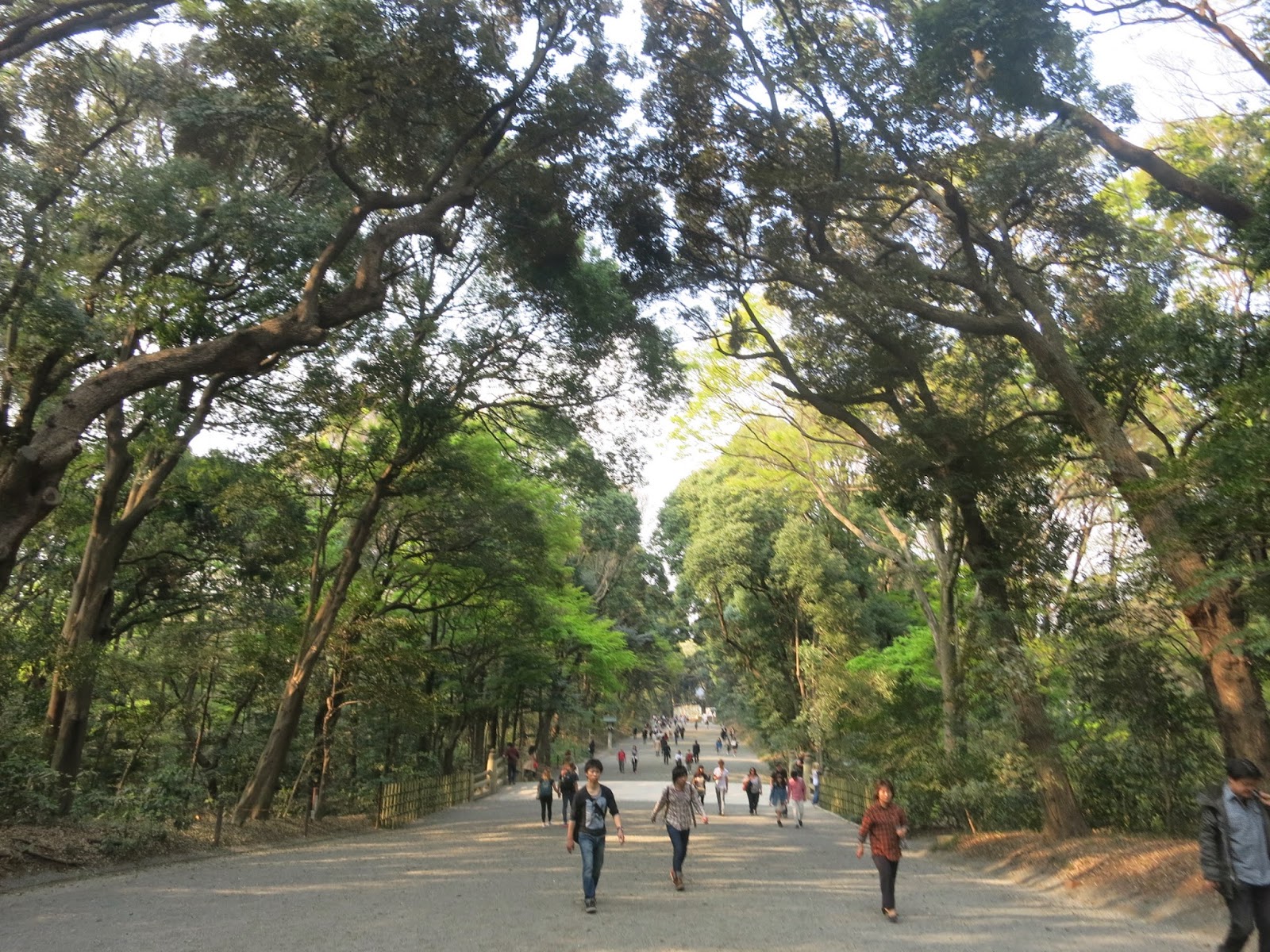
Here's the pathway to the Meiji Shrine. It's a long walk - maybe 1 km long from the entrance - and the entire pathway is covered with gravel. The sound you produce while walking makes you very aware of the nature around you.
Long walk to the Meiji Shrine
The Meiji Shrine is located in Shibuya, Tokyo's main shopping district. It's so hard to imagine that in the midst of tall buildings and modern architecture, there's a forest that houses a shrine. According to Wikipedia, the forest is about 700,000 sqm or 175 acres, and there are about 120,000 trees. Wow. At the entrance of Shinto temples, you'll also sometimes see stacks of sake drums which are offerings to the deities.
Before entering the temple, there is also a section where you can wash your hands and rinse your mouth – again this is part of cleansing before worshipping the gods.
Here are some photos of the Asakusa Kannon Temple grounds. Photography is usually banned inside the temple.
Asakusa Kannon Temple Gate
Asakusa Kannon Temple
Asakusa Kannon Temple grounds
At the Meiji Shrine, we chanced upon a ceremony. I think they had this special ceremony for newly-ordained priests. We were only allowed to take photos during the processional.
Shinto priests
In Shinto temples, people write their prayers on a slip of paper and tie them to a tree. People can also purchase small wooden boards called ema where they write their wishes or prayer petitions. The paper or wood board prayers are left outside in the belief that the wind carries the wishes out into the world.
Ema or prayer petitions
In Shinto temples (as well as Buddhist temples), you’ll notice a section where there’s a set of drawers (like the photo below) which contains strips of paper inside. These strips of paper are called O-mikuji which bears a fortune reading. To get an o-mikuji, you usually make a small offering, then pick a stick from a wooden box. The stick has a number and whatever number you pick, look for its corresponding drawer and get your fortune reading from there.
O-mikuji
O-mikuji section at the Asakusa Temple
The fortune could be a big or small blessing and it could be a curse too.When the prediction is bad, you could fold up the strip of paper and attach it to a tree or wall of wires. It is believed that bad luck will wait by the tree rather than attach itself to the bearer. If the fortune is good, the bearer can keep the strip of paper for luck or he/she can also tie it to the tree or wall of wires.
O-mikuji tied to a wall of wires
BTW, if you're visiting the Asakusa Kannon Temple, don't forget to quickly breeze through the Nakamise Shopping street - it's a long strip of stores selling souvenirs and delicacies.
Shinto is one of the two major religions in Japan (the other one is Buddhism). Shinto is about living in harmony with nature and all things.
We visited 3 Shinto temples in Japan and the Heian Shrine in Kyoto is one of them.
Here is the main gate leading to the Heian Shrine.
Upon entering a Shinto Shrine, worshippers wash their hands and rinse their mouth because cleanliness is a sign of respect to the deities. This is where you can cleanse yourself.
Usually, Shinto temple grounds are also covered with white sand or gravel. According to our tour guide, the sound your walk produces – shoes scratching against the gravel – is also part of the cleansing as you walk towards the temple.
This is the Heian Shrine which dates back to 1895. It was built to commemorate the 1,100th anniversary of Kyoto (Japan's old capital before it was moved to Tokyo). It is dedicated to the spirits of the first and last emperors who reigned the city. The word "Heian" is actually the old name of Kyoto.
Just like Buddhist temples, you can also write your wishes and petitions on wooden boards like these.
You can also write your prayers and wishes on paper and tie them on trees. From afar, I actually thought these trees were cherry blossoms. Haha...
The paper and wooden boards bearing the prayers are just left outside in the belief that the wind carries the wishes out into the world. Within the grounds, you can also find some sakura or cherry blossoms. The shrine is most popular for its weeping cherry trees.
“Kiyomizu” in Japanese means clear water or pure water and “dera” means temple. Thus, Kiyomizu-dera when translated in English means “pure water temple”.
This is the pathway leading to Kiyomizu-dera.
The pathway is lined up with stores selling Japanese souvenirs, delicacies and potteries. These shops have been catering to pilgrims and tourists for centuries.
But do your shopping after visiting the temple to make sure your arms are free when you take photos. :)
Kiyomizu-dera, a Buddhist temple, was founded in 798 in Kyoto (Japan's capital for more than 1,000 years before it was moved to Tokyo). But the buildings we see today were constructed in the 17th century. The place has been declared a UNESCO World Heritage site. It was also one of the 21 finalists for the New 7 Wonders of the World in 2007.
This is the gate that leads to the temple.
Right before reaching the temple, you'll see wooden ornaments like these. These are prayer petitions or wishes of visitors.
Prayer petitions
This is the main temple - the popular Kiyomizu-dera.
Kiyomizu-dera
This structure was constructed without using a single nail!
The wooden pillars that support the temple are 13 meters high. Did you know that during the Japanese Edo Period which was between the 17th and 19th century, there was a popular expression in Japan which means “to jump off the stage at Kiyomizu” or in English, “to take the plunge”. And they literally meant a physical plunge!
During the Edo period, there was a tradition that if you were to survive the 13 meter jump from the stage, one’s wish will be granted.According to Wikipedia, there were 234 jumps recorded and out of these, about 200 survived. Good thing, this practice has been prohibited!
Anyway, from the veranda, here’s the beautiful view of Kyoto.
Kyoto
And here’s the view of the Otowa waterfall (upper left corner of the photo) and a souvenir store - also taken from the temple veranda.
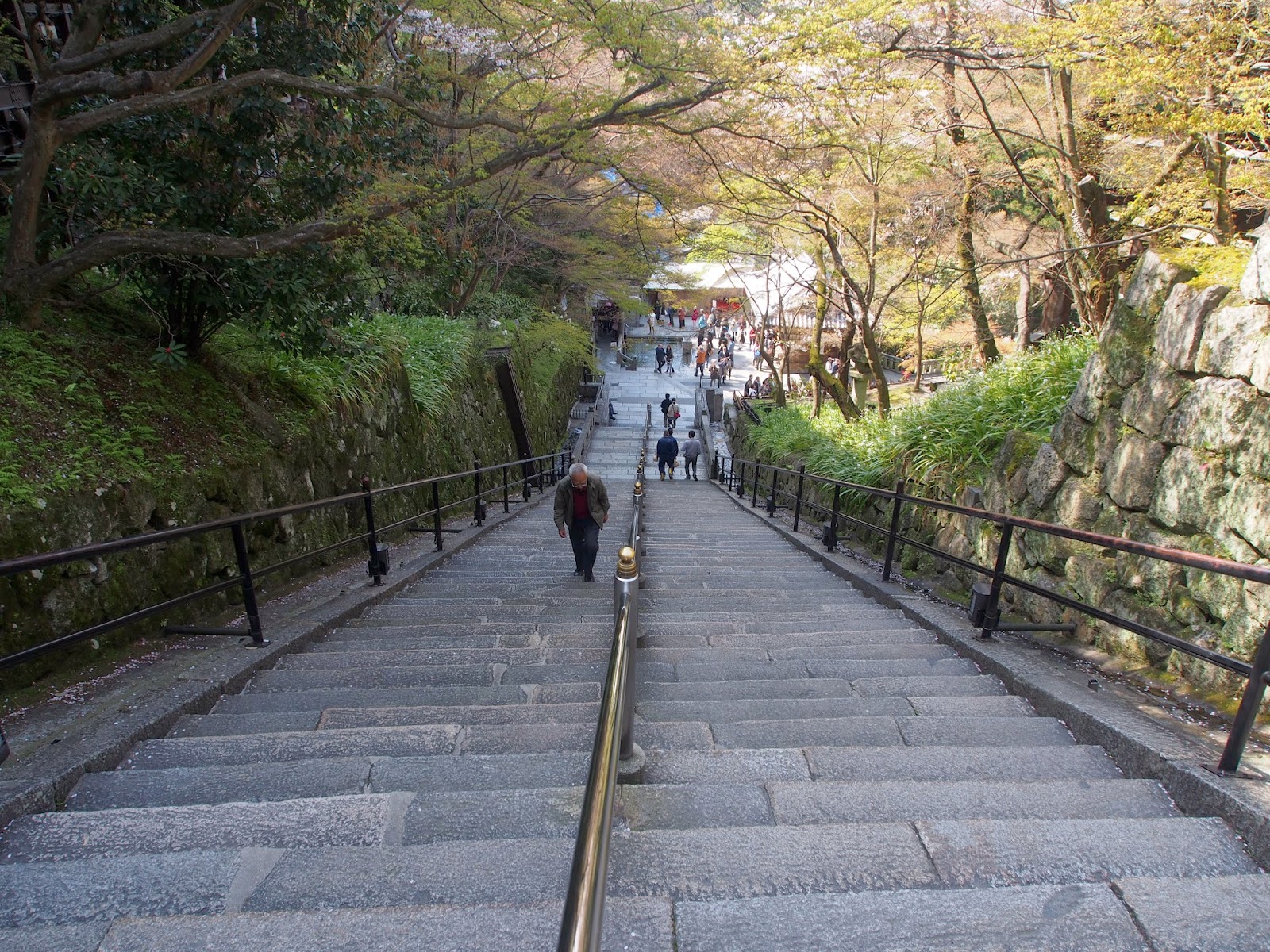
You have to go down these steps to get to the Otowa waterfall.
The Otowa waterfall has 3 streams of water that fall into a pond. Each water stream represents success in an area - one is love, another is longevity and the third, studies or career. The belief is you have to catch and drink water from your selected stream to enjoy the benefit. But you can’t drink from all the 3 streams because it is considered greedy. Nope, we didn't line up to catch and drink water because we wanted all 3! Haha...
Visitors catching water to drink from the Otowa waterfall.
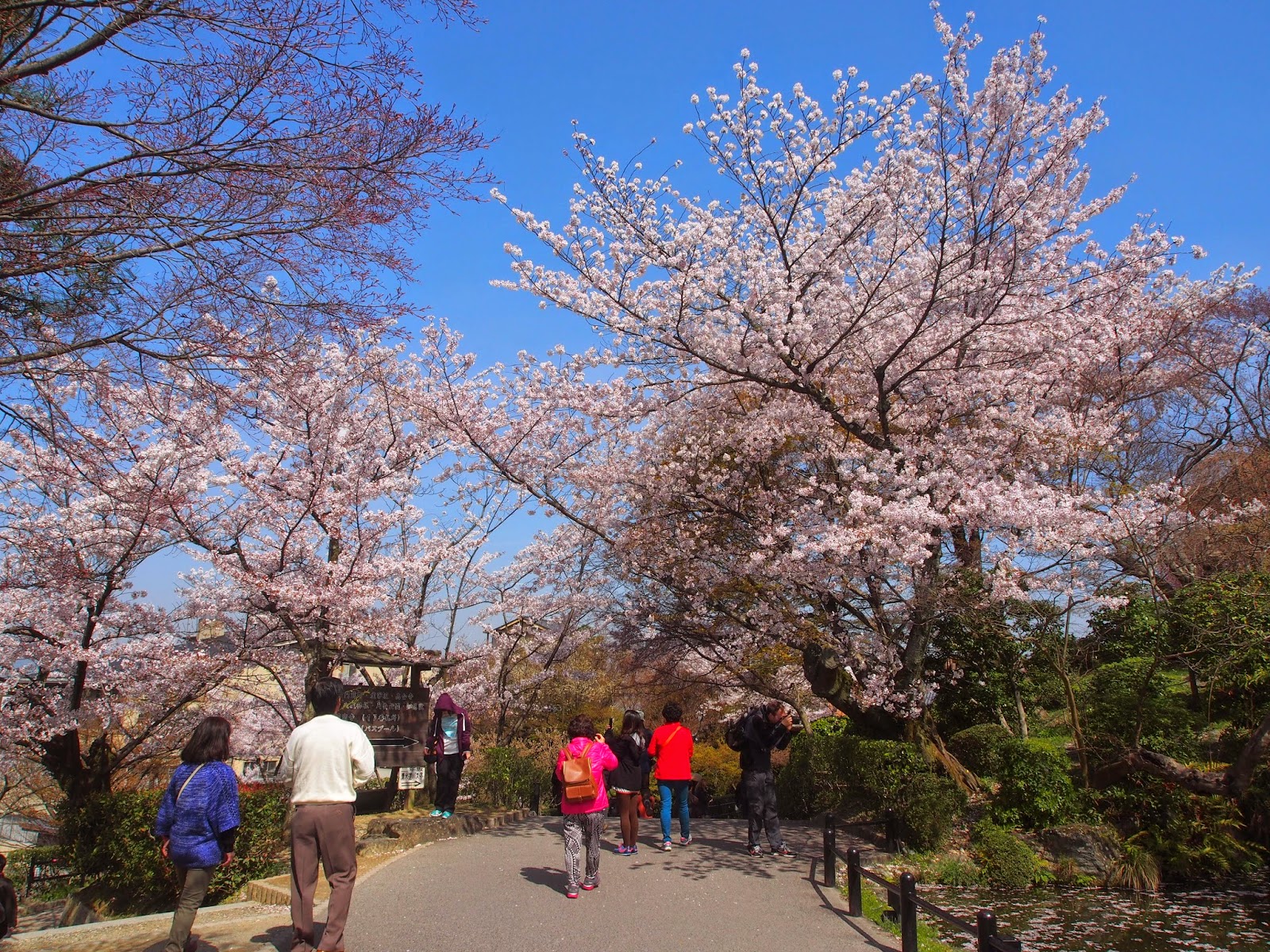
Within the grounds of Kiyomizu-dera are beautiful cherry blossoms (sakura). We were there on April 7 so the season was about the end already but still breathtaking! :)
While exploring the grounds, we also saw a Japanese cemetery.
This is how Japanese tomb stones look like.
While in Kiyomizu-dera, you can also rent out Japanese kimonos if you want to take the Japanese experience a notch higher. Here are some ladies we spotted wearing kimonos.